Most leaders do not experience themselves in the same way others experience them.
They may believe they are communicating clearly, remaining composed under pressure, empowering others effectively, or influencing strategically, while colleagues, direct reports, and key stakeholders experience something different. Equally, many leaders underestimate strengths that are already highly visible to those around them. This is one of the most valuable aspects of a 360° feedback process.
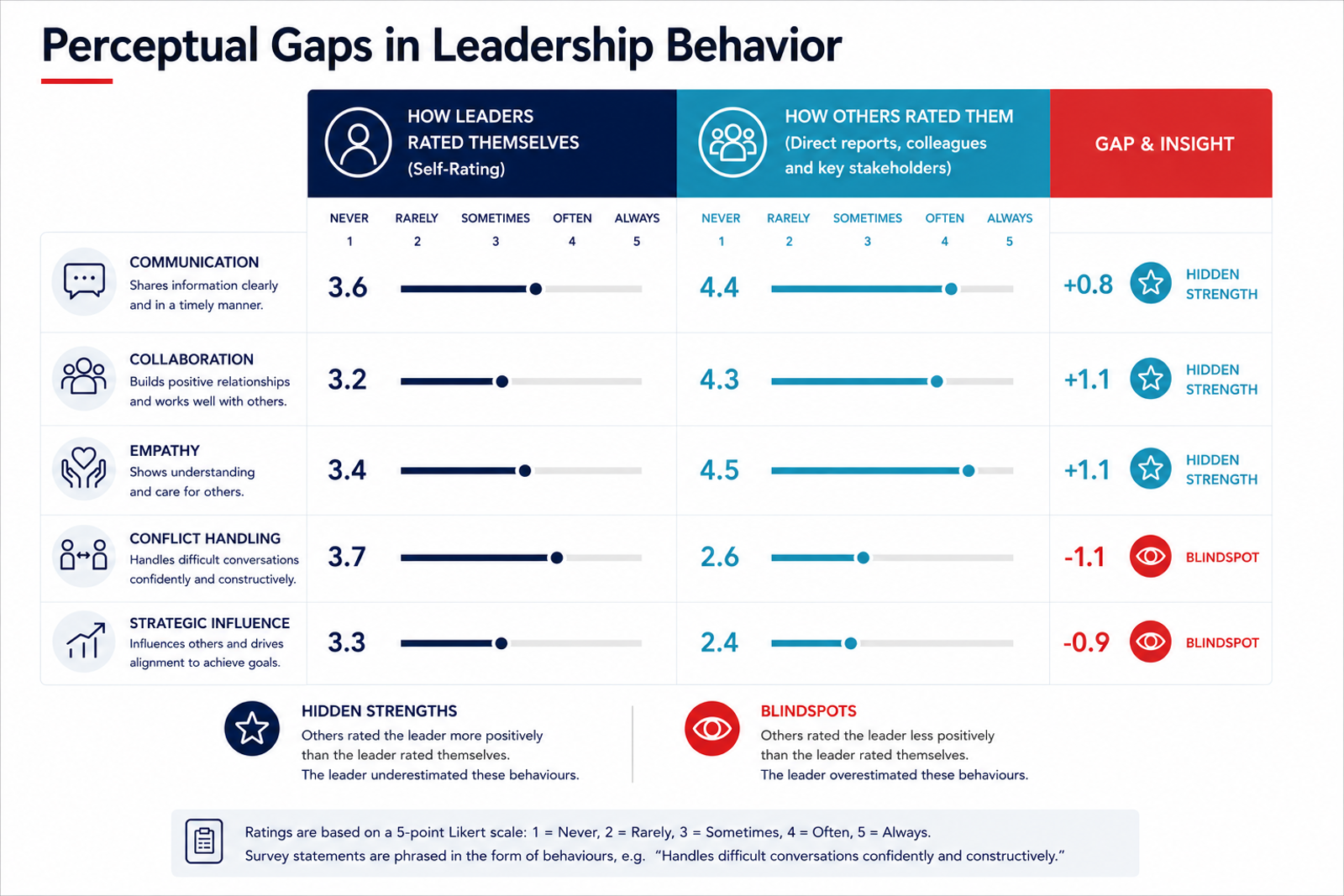
Figure 1: Perceptual Gaps in Leadership Behaviour. Illustrative example comparing a leader’s self-ratings against others’ ratings across five behaviours. Data is fictional and represents one leader’s results in a typical 360° review.
360° surveys are designed to surface these perceptual gaps by comparing how leaders see themselves with how they are experienced by others across the organisation. Rather than focusing only on scores, the process highlights patterns, themes, blind spots, and hidden strengths that are often difficult to identify through traditional performance conversations alone. Research studies on 360° feedback consistently show that these perceptual gaps matter. Leaders who significantly overestimate themselves are more likely to experience challenges relating to teamwork, trust, communication, and organisational alignment.
Leaders who are more accurate in how they see themselves, or who modestly underestimate themselves relative to others, are often rated more positively on teamwork, communication, emotional intelligence, and interpersonal effectiveness.
Why is this important?
Because leadership is shaped not only by intention, but by perception.
How leaders are experienced by others influences trust, engagement, collaboration, team dynamics, and culture. Large gaps between self-perception and external perception can lead to misunderstandings, reduced trust, disengagement, and missed development opportunities.
For example, leaders who consistently overestimate themselves may be unaware that others experience them as unclear, reactive, or difficult to approach. These kinds of gaps are often associated with challenges relating to teamwork, trust, and performance.
At the same time, leaders who consistently underestimate themselves may fail to recognise strengths that are already positively impacting others. As a result, they may hold back from broader influence, visibility, strategic contribution, or leadership opportunities despite others already experiencing them positively.
One of the clearest examples of this dynamic comes from the “Hidden Strengths” and “Blind Spots” sections of Omnicor’s 360° feedback report.
A hidden strength emerges when others consistently rate a leader more positively than the leader rates themselves. Blind spots work in the opposite direction. These occur where leaders rate themselves more positively than others experience them.
Large perceptual gaps between leaders and teams can negatively affect team climate, knowledge sharing, learning, and performance. In many cases, the risk is not simply the behaviour itself, but the fact that the leader is unaware of how others are experiencing it.
360° feedback also reveals how differently the same leader can be experienced across rater groups like direct reports, managers, and peers.
Key stakeholders may experience someone as highly strategic and influential, while peers may experience the same person differently in collaborative or operational contexts. the Direct reports frequently see a leader’s everyday strengths, like how they coach, support, and remove obstacles, as well as frustrations, like inconsistency or lack of follow-through, that rarely reach the managers and executives above them.
These differences matter because leaders rarely operate in only one relational context.
The goal of a 360° process is therefore not simply evaluation. It is self-awareness.
When facilitated effectively, these conversations help leaders:
- Understand how they are experienced,
- Identify recurring behavioural patterns,
- Recognise hidden strengths,
- Understand potential blind spots,
- Navigate leadership transitions more effectively, and
- Become more intentional in how they lead others.
The most meaningful leadership development often begins when individuals are able to see themselves through the eyes of others.
Omnicor has spent the last 24 years perfecting the science of multi-rater feedback. If you’re curious about your leadership brand within your organisation, email colleen@omnicor.co.za and we’ll give you a 360° experience on the house.
References:
Caldwell, C. (2026). Resolving the leadership blind spot. The Journal of Values-Based Leadership, 19(1).
Larsson, G. (2024). Leaders’ tendency to over- and underestimate themselves and their organizations: The subordinates’ perception. Chronicles of Behavioral Psychology, 2(2), 87–101.
Vogel, D., & Kroll, A. (2019). Agreeing to disagree? Explaining self–other disagreement on leadership behaviour. Public Management Review, 21(12), 1867–1889.
Lee, A., & Carpenter, N. C. (2017). Seeing eye to eye: A meta-analysis of self-other agreement of leadership. The Leadership Quarterly, 29(2), 253–275.
Tafvelin, S., Schwarz, U. V. T., & Hasson, H. (2017). In agreement? Leader-team perceptual distance in organizational learning affects work performance. Journal of Business Research, 75, 1–7.
Fleenor, J. W., Smither, J. W., Atwater, L. E., Braddy, P. W., & Sturm, R. E. (2010). Self–other rating agreement in leadership: A review. The Leadership Quarterly, 21(6), 1005–1034.
Gibson, C. B., Cooper, C. D., & Conger, J. A. (2009). Do you see what we see? The complex effects of perceptual distance between leaders and teams. Journal of Applied Psychology, 94(1), 62–76.
Atkins, P. W. B., & Wood, R. E. (2002). Self‐ versus others’ ratings as predictors of assessment center ratings: Validation evidence for 360‐degree feedback programs. Personnel Psychology, 55(4), 871–904.