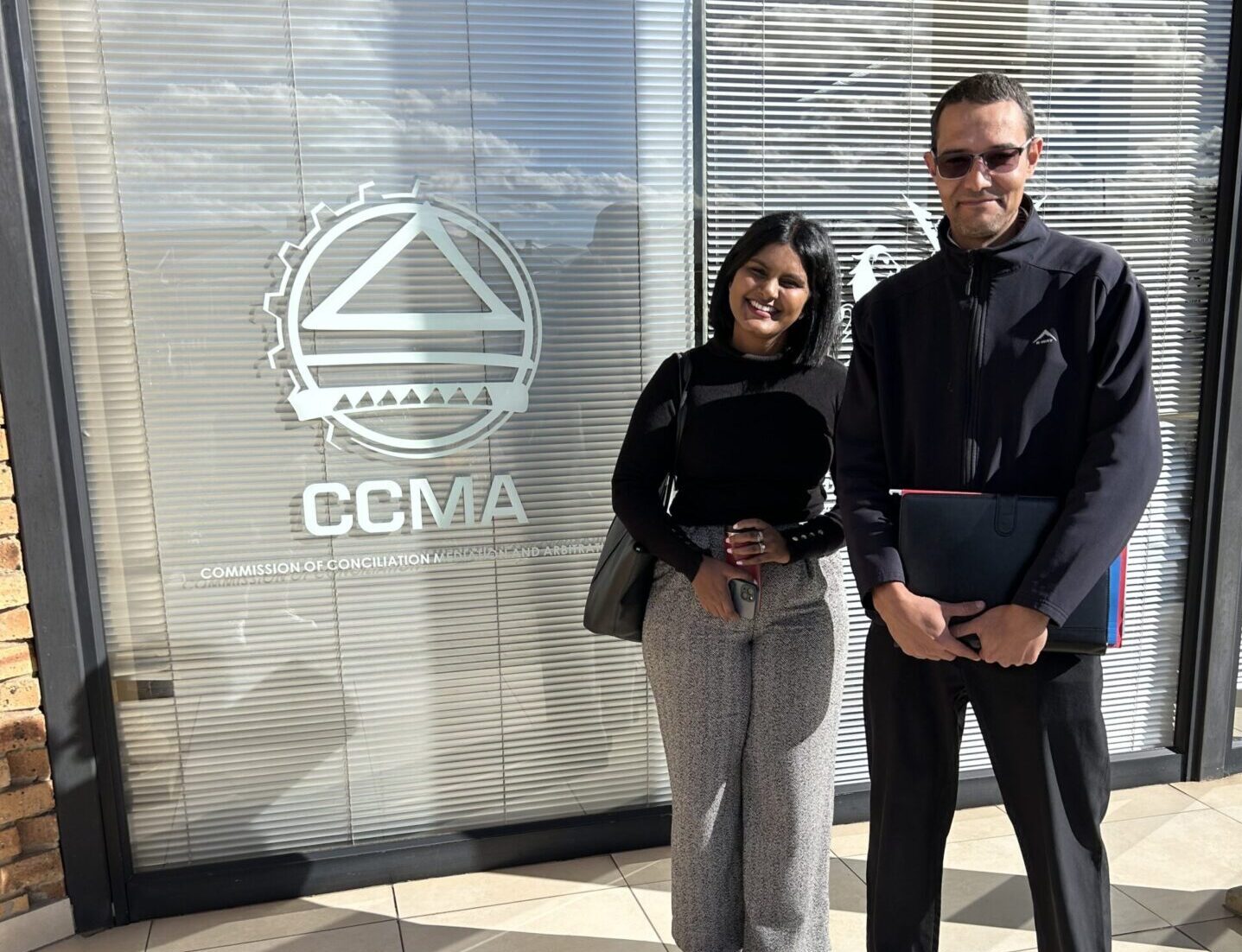
As part of my Industrial Psychology internship at Omnicor, I recently had the opportunity to observe two live CCMA matters. It was one of the most meaningful learning experiences of my internship and I wanted to share what I took away from the day.
Industrial Psychology covers a wide range of disciplines from psychometric assessments and career development to organisational behaviour and labour relations. As an IOP intern, I spend a lot of my time in the world of people and assessments. Labour relations, however, is something I had mostly only engaged with through theory. Last week, that changed.
Through Andrew Croucamp of People Relations Solutions, Omnicor’s external HR, I was invited to observe two matters at the CCMA in Vereeniging. I want to be clear that I attended purely in a learning capacity, and full confidentiality of all parties has been maintained.
The two matters I observed were very different from each other. One was a conciliation hearing where the commissioner guided the parties toward a resolution. The other was more procedurally complex involving a rescission application where an arbitration award was being challenged, and the matter needed to be carefully unpacked before it could move forward. Both required the commissioner to manage multiple parties, navigate language barriers, and guide people through a process many were experiencing for the first time.
What made the day even more valuable as an IOP intern was being able to observe two very different roles in action simultaneously. Watching the commissioner manage the proceedings, remain neutral, explain complex processes in plain language, and ensure all parties felt heard was a reminder that this is a role that draws heavily on skills we develop as Industrial Psychologists: communication, fairness, emotional intelligence, and sound judgement under pressure. On the other side, observing Andrew as the Labour Relations Consultant representing the employer showed me what it looks like to navigate labour matters strategically, confidently, and ethically in practice. Both roles, commissioner and Labour Relations Consultant, are legitimate and meaningful career paths for IOP graduates and getting exposure in employee relations and labour relations early in your career can open doors that you may not have even considered.
My Key Takeaways as an IOP Intern
- Theory and practice are not the same thing. The CCMA operates very differently from how it is described in textbooks. Commissioners have wide discretion, proceedings are informal by design, and the process is adapted to the people in the room. In fact, commissioners are required to actively assist unrepresented parties to ensure no one is disadvantaged simply because they do not know the law.
- The human element is everything. Behind every matter is a person navigating one of the most stressful experiences of their working life. As an IOP intern, this was a powerful reminder that empathy and fairness must sit at the centre of everything we do as practitioners regardless of the domain we work in.
- Procedural fairness has real consequences. I observed first-hand how procedural steps when missed or incorrectly followed can significantly affect the outcome of a matter and the accessibility of justice for all parties involved.
- The CCMA is not a one-size-fits-all process. Not every claim that comes before the CCMA falls within its jurisdiction. Part of what I observed was how a commissioner redirects parties to the appropriate processes when needed, which requires both legal knowledge and strong communication skills.
- Labour relations is deeply connected to who we are as IOP practitioners. Understanding how workplace disputes arise, how power dynamics play out, and how people experience dignity and fairness at work is not just a legal matter; it is very much an Industrial Psychology matter.
A huge thank you to Andrew Croucamp of People Relations Solutions for generously allowing me to observe his matters and for taking the time to debrief me afterwards. His willingness to walk me through the practical realities of what I had just witnessed, not just what the theory says, but how things actually work, made this one of the most valuable days of my internship. I am grateful to be surrounded by professionals who genuinely invest in the development of the next generation.
A huge thank you also to Omnicor for creating an internship environment that encourages this kind of practical exposure. Opportunities like this do not happen without an organisation that truly invests in the growth of its interns.
To fellow IOP interns and students if you ever get the opportunity to step outside your usual space and observe how labour relations plays out in practice, take it. You will not regret it.
Author: Coral Ponnadu (IOP Intern)