One of the questions organisations most often bring to Omnicor is when to run their engagement survey. Leaders typically want a specific month, or the ideal day of the week to send it out. What the research shows, however, is that the timing of a survey matters far less than is commonly assumed. What makes the greater difference is something few organisations plan for, which is whether the organisation is prepared to act on what employees’ report.
The evidence on when a survey is sent is clear. In a study of more than 26,000 people, Howard et al. (2024) found no meaningful link between the day an invitation was sent and how many people responded. Response rates varied only slightly across the week.
In practice, the day and time a survey is distributed make little difference to participation. What matters more is practical. Clear support from senior leaders, well-timed reminders, and a response window long enough to accommodate leave all have a greater effect. A response window of about two weeks is generally sufficient, since most responses are received within that period, and completion reminders, rather than a longer window, increase the final response rate.
Timing does matter, but for a different reason than response rates. The purpose of an engagement survey is to provide a steady, comparable picture of how employees experience their work. When a major, organisation-wide event occurs shortly before the survey is distributed, that picture becomes distorted, because the results reflect the event rather than the underlying employee experience.
A few periods are best avoided for a full engagement survey.
- Immediately after pay or performance review outcomes: Employees are likely to respond in reaction to these outcomes, rather than offering a considered view of their overall experience.
- During restructuring or retrenchment: Engagement typically declines around these events, so the results reflect the disruption rather than a normal operating period.
- Around leadership changes, mergers or major change programmes: Responses tend to reflect the uncertainty of the transition rather than the underlying employee experience.
- Over year-end and peak holiday periods: Attention is limited, and participation tends to be lower.
During periods of significant disruption, a short pulse survey, which is a brief and focused check-in, is often more appropriate than the full survey. It allows leaders to gauge how employees are responding to the change, while the full survey is best held until conditions stabilise, so that year-on-year comparisons remain valid.
The most important research finding moves the question away from timing altogether. Reviewing more than twenty academic studies, McKinsey (2021) found that the primary cause of survey fatigue was not the number of surveys, their length, or the timing of their distribution. It was the perception that the organisation would not act on the results. Where organisations are seen to act, employees are more willing to participate again and to respond openly. Employees rarely disengage from surveys because they are asked too frequently. They disengage when previous feedback has led to no visible change.
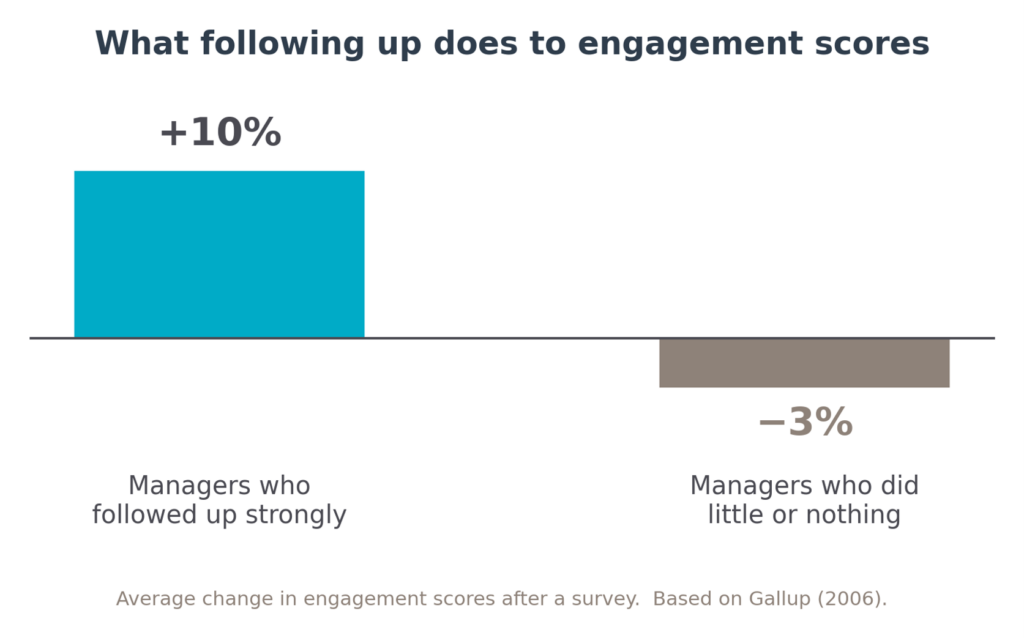
The consequences of gathering feedback without acting on it are significant. Gallup’s long-running research found that teams whose managers followed up strongly on their results improved their engagement scores by about 10%, while teams with little or no follow-up saw theirs decline by about 3%.
The gap between gathering feedback and acting on it is well documented. Research across many organisations shows that while most share their results with employees, fewer convert them into a clear plan of action, and only around half of these report visible improvements as a result. Gaps in follow-through tend to erode trust and reduce employees’ willingness to take part in future. The implication is straightforward. How often an organisation surveys should be governed not by how much employees will tolerate, but by how much it can realistically act on. An organisation should survey only as often as it can respond meaningfully to what it learns.
The most effective approach combines several ways of gathering feedback rather than relying on a single survey.
- A full survey once or twice a year: Held at the same time each year, so that results remain comparable.
- Shorter pulse surveys in between: Spaced at least three months apart when addressing something broad, such as a culture change, because change takes time to show.
- Brief check-ins at key moments: When employees join, are promoted or leave, which fall between annual survey cycles.
Timing can also be used to an organisation’s advantage. Running a full survey shortly before strategy and budgets are set allows the findings to shape those decisions while they are still open.
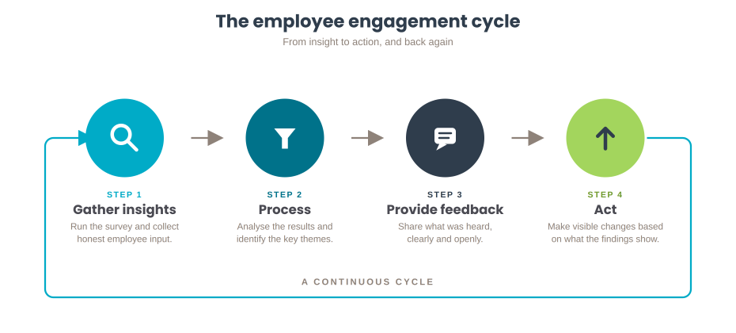
What determines whether a survey builds or erodes engagement is not when it is sent, but what happens afterwards. A few practical points follow:
- Choose a calm, consistent window: Run the full survey at the same time each year and avoid periods of major disruption, so that results stay comparable.
- Rely on reminders and visible leadership support: These do more to increase response rates than the timing of the survey.
- Align the survey with the planning cycle: Running it shortly before strategy and budgets are set lets the findings shape those decisions.
- Ensure readiness to act before surveying again: Follow-through matters more than the date and acting on results is what sustains trust and future participation.
Survey timing is not where the real decision lies. The harder question is what the organisation is prepared to change once the results are in. That decision is best made before the survey goes out, not after. A survey is not a measurement exercise but the first step in a process, and it earns its value only when that process is carried through. With that settled, when to run the survey matters far less, and the real work begins where the survey ends.
Omnicor partners with organisations to design and run leadership, coaching and employee-engagement processes that turn insight into lasting development. To discuss your engagement survey approach, contact us
References:
Gallup. (2006). What to do with employee survey results. Gallup Business Journal. https://news.gallup.com/businessjournal/23956/what-to-do-with-employee-survey-results.aspx
Howard, C., Greaves, L. M., Osborne, D., & Sibley, C. G. (2024). Is there a day of the week effect on panel response rate to an online questionnaire email invitation? Journal of Survey Statistics and Methodology, 12(1), 94–104. https://doi.org/10.1093/jssam/smad014
McKinsey & Company. (2021). Survey fatigue? Blame the leader, not the question. https://www.mckinsey.com/capabilities/people-and-organizational-performance/our-insights/the-organization-blog/survey-fatigue-blame-the-leader-not-the-question
Perceptyx. (2025). The state of employee listening 2025. https://go.perceptyx.com/research-the-state-of-employee-listening-2025
Qualtrics. (n.d.). When to run an employee engagement survey. Retrieved September 9, 2026, from https://www.qualtrics.com/experience-management/employee/when-to-run-engagement-survey/
Society for Human Resource Management. (2023). Checking the pulse: The benefits of conducting employee surveys more frequently. https://www.shrm.org/executive-network/insights/checking-pulse-benefits-conducting-employee-surveys-frequently
Workforce Science Associates. (n.d.). Less means more: Employee engagement survey frequency. Retrieved September 9, 2026, from https://workforcescience.com/learn/articles/less-means-more-employee-engagement-survey-frequency/