A 360° feedback process offers a valuable view of how others perceive an individual. It can reinforce strengths, highlight development areas, surface blind spots and reveal gaps between how we see ourselves and how others see us. However, awareness alone does not produce change.
What happens after the feedback is received depends on reflection, focused development goals, opportunities to apply new behaviours, accountability and continued support.
The key features underpinning Omnicor's PDP
The design of Omnicor’s PDP reflects established principles in leadership development and personal development planning. These principles have been built into our PDP template and are outlined below:
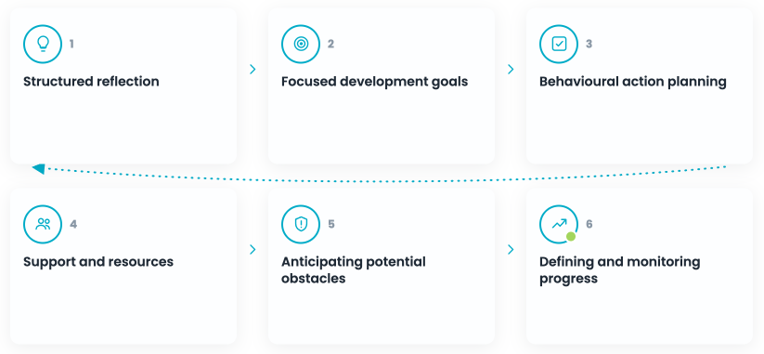
1. Structured reflection
The PDP begins with focused reflection on the key themes from the 360° report: strengths, development areas, hidden strengths and blind spots. This helps individuals consider what matters most for their role, responsibilities and future aspirations before deciding where to focus their development.
2. Focused development goals
Once priorities are clear, individuals are guided to formulate SMART development goals. This gives direction and helps ensure that objectives are specific, realistic and defined well enough to support action and review over time.
3. Behavioural action planning
The PDP prompts individuals to identify what they need to stop, start and continue doing. This keeps the focus on observable behaviour and turns broad development intentions into actions that can be applied in day-to-day work.
4. Support and resources
When populating the PDP template, individuals are required to consider the resources they may need and the people who can support their development, including a manager, coach or colleague. Development is stronger when individuals have access to relevant support, feedback and opportunities to practise new behaviours.
5. Anticipating potential obstacles
The PDP includes space to identify factors that may hinder progress. Considering these upfront supports more realistic planning and helps individuals address obstacles before they stall momentum.
6. Defining and monitoring progress
Once the steps above have been completed, individuals need to define what success will look like and how they will track progress. This creates a basis for accountability and ongoing review, keeping development priorities active beyond the initial feedback session.
From insight to action
Together, these features provide a structured approach for carrying 360° feedback forward into continued development. Rather than ending with insight, the process creates a practical basis for reflection, action and review.
For leaders, the PDP is not a document to complete once and file away, but one to revisit as goals are met, priorities shift, and new feedback emerges. For organisations, it offers a consistent way to keep 360° feedback connected to visible, ongoing development, rather than a single point-in-time exercise.
For organisations looking to move 360° feedback beyond insight and into sustained development, Omnicor’s integrated PDP provides a practical next step. Contact us to learn more.
References:
- Phillipson, J., Pinto, A.C., Kingsley-Smith, H., Krachler, N., McGivern, G. & Lyons, O. (2025). Leadership training in healthcare: a systematic umbrella review. A current, high-level source: across 86 reviews, effective leadership development was associated with experiential learning, coaching or mentoring, longitudinal development, goal setting and 360° feedback.
- Emam, S.M., Fakhry, S.F. & Abdrabou, H.M. (2024). Leaders development program by 360-degree feedback: reflection on head nurses’ leadership practices. BMC Nursing, 23, 772. Evaluates 360° feedback as part of a structured leadership development programme and reports improvements in leadership practices that remained evident at follow-up.
- Hu, S. et al. (2024). Coaching to develop leadership of healthcare managers: a mixed-methods systematic review. BMC Medical Education, 24, 1083. Supports the emphasis on coaching, reflection and continued developmental support rather than treating feedback as a once-off intervention.
- Mbokota, G. & Reid, A. (2022). The role of group coaching in developing leadership effectiveness in a business school leadership development programme. South African Journal of Business Management, 53(1). A South African study in which the programme combined 360° multi-source feedback, structured coaching and a PDP focused on longer-term goals and actions.
- Lejeune, C., Mercuri, D., Beausaert, S. & Raemdonck, I. (2016). Personal development plans supporting employee learning and perceived performance: the moderating role of self-directedness. Human Resource Development International, 19(4), 307–328. The source most directly relevant to the PDP itself, rather than only to 360° feedback or coaching.