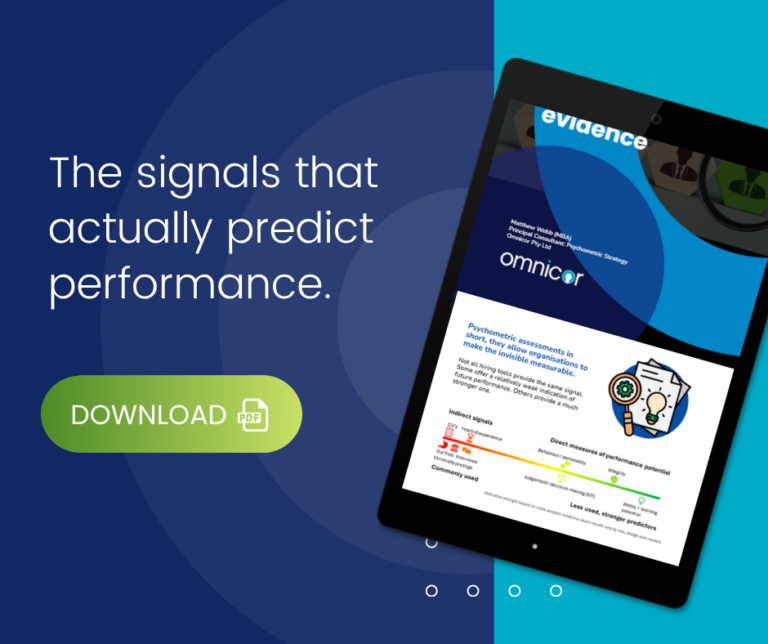
Since the late 1990s, research by Schmidt and Hunter (1998) firmly established that psychometric assessments are among the strongest predictors of workplace performance. More recently, Sackett, Zhang, Berry, and Lievens (2021) highlighted the important role of structured interviews in enhancing the accuracy of hiring decisions.
From this research, we understand that effective recruitment involves four or five key puzzle pieces coming together: qualifications, experience, interview insights, reference feedback, and psychometric data. Leaving any one of these out creates blind spots in hiring decisions.
Psychometrics, in particular, help fill in the gaps often difficult to observe through interviews or CVs alone, such as cognitive agility, personality traits like conscientiousness, or role-specific capabilities. Not doing psychometrics usually means leaving these important dimensions to chance.
That said, assessments are often viewed as the “costly part” of recruitment, with fees ranging from R3,500 to approximately R15,000 per candidate. As a result, many companies place them near the end of the process, after CV screening, interviews, and reference checks.
Unfortunately, this sequencing can unintentionally create a serious misperception: that the psychometric assessment is the final decision-maker. That’s incorrect.
To illustrate, imagine I’m applying to work at Omnicor as a Psychometrist. I have the right qualifications and experience, and the hiring manager is impressed by the way I present myself. However, my psychometric results show a misalignment with the values or thinking style needed for the role.
At this point, the hiring manager might still choose to proceed.
So, did the psychometrics decide my fate? No. They contributed to a more balanced, holistic process. That decision would be based on how they interpret the whole picture: my track record, achievements, and potential, alongside the psychometric insights.
If I’m selected, it’s not because I “passed” the assessment. If I’m not selected, it’s not because I “failed” it. The psychometric results simply offered additional insight to inform a more confident decision.
I believe most managers and HR professionals already understand the value of holistic decision-making. After all, if they didn’t, companies like Omnicor wouldn’t exist.
But we also work in a country where unemployment is nearly 40%. Not being selected for a role is not only disappointing, but it could impact basic survival. It is no wonder that giving negative feedback to an applicant is so hard. Sometimes, it’s easy to blame the psychometrics since that was the last part of the process, and frankly, it is not something the HR professional or Line manager is responsible for. Or are they?
In reality, the way we communicate matters.
When candidates are told they “Failed the psychometrics,” it’s not just misleading; it’s dangerous. Even if it’s the final step in the process, saying that the test caused the rejection is inaccurate and opens the door to risk.
These risks include:
- Findings of unfair discrimination (under the Employment Equity Act) against the company
- CCMA disputes or Labour Court challenges
- Financial penalties, or orders to rerun the process
In the case of Pratten v Afrisun KZN (Pty) Ltd (2020), the Labour Court made it clear:
- Psychometric results cannot be used in isolation
- They must be considered alongside technical competencies and other relevant data
This judgment reinforces what ethical practice already demands: psychometric assessments are just one part of the whole picture.
Even when HR teams and managers understand this in principle, a poorly worded explanation, like “you didn’t get the job because you failed the assessment”, can lead to reputational, ethical, and legal risks.
To ensure fair and consistent communication, we recommend using language like this for written feedback:
“Thank you for participating in the selection process. We have carefully considered all aspects of your application, including your CV, past performance, references, and psychometric assessment results.
After reviewing the complete set of information, we regret to inform you that your application does not closely match the key requirements for this particular role. As such, we will not be proceeding further.
We appreciate the time and effort you invested. If you’d like to receive general developmental feedback from the assessment process, we will happily arrange this through Omnicor.”
Or, for verbal feedback:
“Thanks again for being part of the process. After considering your experience, references, and the assessment results, we’ve decided not to move forward, as the combination of factors didn’t fully match what’s needed for this role.”
This approach maintains transparency while reinforcing that hiring is a multidimensional decision, guided by science, ethics, and sound business practice.
Author: Tashreek Davis, a Senior Psychometrist at Omnicor
View the Employee Assessments page to learn more:
https://omnicor.co/pre-employment-psychometric-assessment-testing/
References
Schmidt, F. L., & Hunter, J. E. (1998). The validity and utility of selection methods in personnel psychology: Practical and theoretical implications of 85 years of research findings. Psychological Bulletin, 124(2), 262–274.
Sackett, P. R., Zhang, C., Berry, C. M., & Lievens, F. (2021). Revisiting meta-analytic estimates of validity in personnel selection: Addressing systematic overcorrection for restriction of range. Journal of Applied Psychology, 106(11), 1607–1632.
Pratten v. Afrisun KZN (Pty) Ltd, (2020) 31 SALLR 159 (LC)